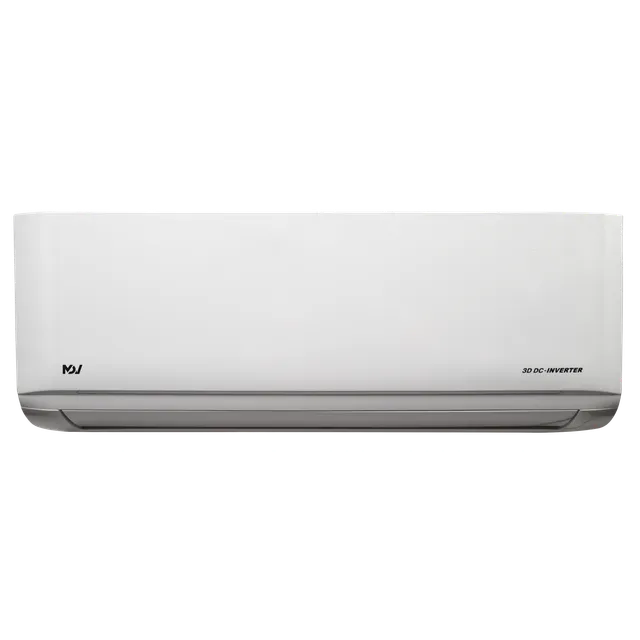
In short. An air conditioner with heating is also a heat pump, just air-to-air: it takes heat from outdoors and warms the room air. An air-to-water heat pump takes heat the same way but heats water for radiators, underfloor heating and a hot-water tank. For a flat, an air conditioner almost always wins. For a house you want to take fully off gas, look at air-to-water. Most often the best setup is a combination: the boiler stays and air conditioners heat in autumn and spring.

The difference
Both work the same way: they move heat from outdoors to indoors and give 2–4 kWh of heat per 1 kWh of electricity. The difference is what they heat and how they fit into the house.
| Air conditioner (air-to-air) | Air-to-water heat pump | |
|---|---|---|
| What it heats | Room air | Water: radiators, underfloor, hot-water tank |
| Hot water | No | Yes, via a tank or built-in cylinder |
| How many rooms | One; for a house, a unit per room or a multi-split | The whole house through the heating system |
| How it heats | Fast: a room warms up in minutes | Slow and even: the system has inertia |
| In summer | Cools | Usually hot water only |
| Installation | 3–5 hours, no renovation | Needs heating pipework, a tank, hydraulics — it is a project |
| Price | from 12 300 lei installed — a model heating down to −30 °C | quoted for the specific house: pump, tank, pipework, installation. We do not install these systems |
When an air conditioner is enough
- A flat. There is usually nowhere to put an air-to-water unit, while an air conditioner is installed in a day, heats in winter and cools in summer.
- You already have a gas boiler or district heating. The air conditioner covers October–November and March, at about +5…+10 °C, when it is most efficient; the boiler runs only in frost.
- A small house with 2–3 rooms. A multi-split, one outdoor unit for several rooms, usually costs less than an air-to-water pump with a heating system.
For heating, choose a model the manufacturer rates for −25 or −30 °C; they are all in “Air conditioners with heating”.
When to look at air-to-water
- A house with underfloor heating or radiators that you want to take fully off gas, for both heating and hot water.
- A house under construction. Air-to-water is most efficient with low water temperatures, 35–45 °C, i.e. underfloor heating, which is easier to plan before finishing.
- Old cast-iron radiators are designed for water at 70–80 °C. With them the pump may not cope in frost; it needs a calculation and sometimes new radiators.
We do not sell or install air-to-water heat pumps: it is a project built around the house heating system, done by heating designers and installers, and it starts with a heat-loss calculation. If the boiler stays, start with air conditioners that heat: we install them in one day, and, for example, the ZEUS M-Pro 12 heats down to −35 °C and costs 14 210 lei installed.
The money
At the same COP, heat from both costs the same: at autumn 2026 tariffs roughly 90–180 lei per 100 kWh, versus 310 for a gas boiler and 360 for an electric convector. Details are in “How much does heating with an air conditioner cost per month”, and what a house heated by air conditioners costs and how fast it pays back against gas is in “Heat pumps in Moldova: 2026 prices”.
The difference is the entry cost. An air conditioner per room means the unit plus one day of installation. Air-to-water means equipment, a tank, pipework and a project. So for a flat or a house with a working boiler it pays to start with air conditioners; air-to-water makes sense when the house is being built or the heating system is being replaced anyway.
Pick a unit for your room with the one-minute picker; which models heat in frost is covered in “Heating with a reverse-cycle air conditioner”.