In short. In a flat with separate rooms, it does not work: the cold air stays in the hallway and hardly gets into a bedroom on the sunny side. A single unit only makes sense in an open-plan studio where the kitchen and living room are one space. One unit per room is the reliable option, and you can do it gradually, one room at a time.
Why does the cold from the hallway not reach the rooms?
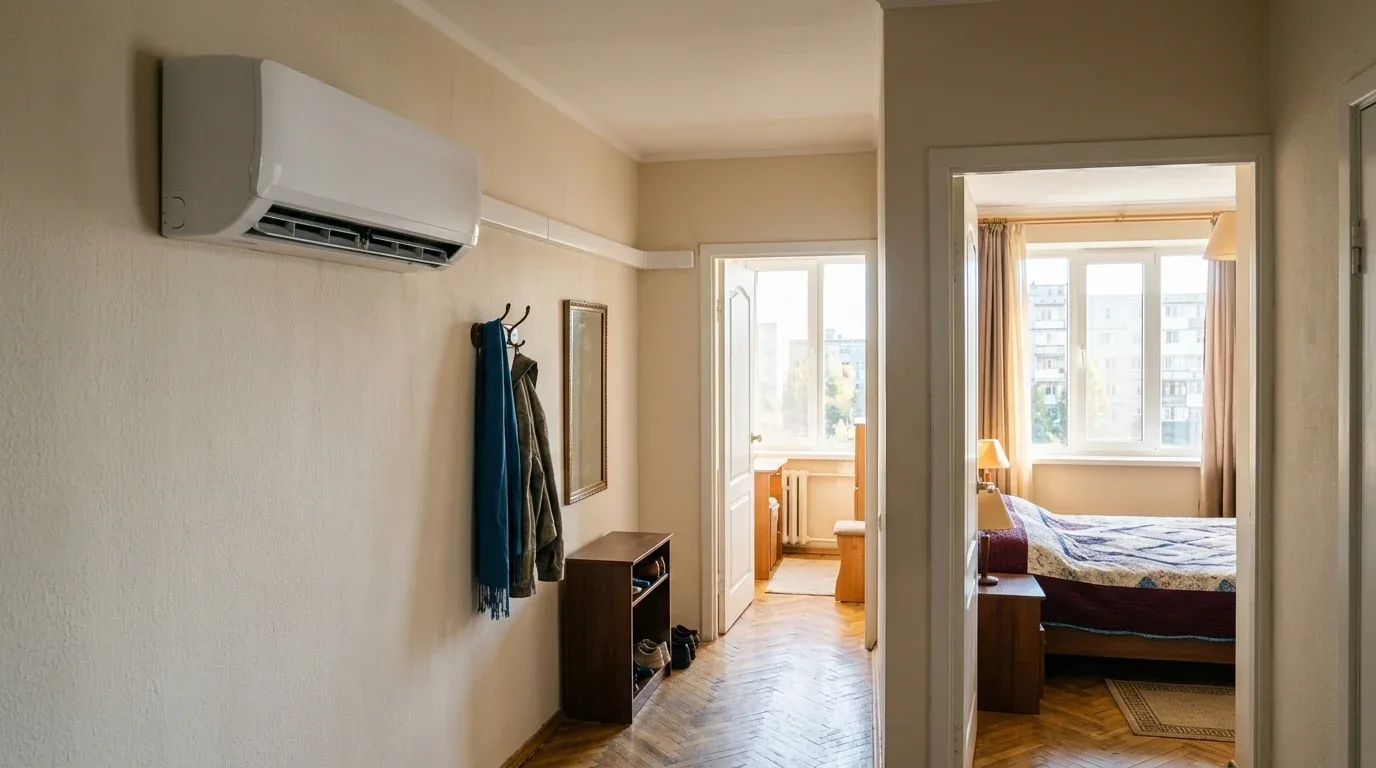
It seems the air will spread through the flat by itself. But cold air needs a flow, and a flat has almost none.
“The air, yes, but you have no airflow. For example, the kitchen has natural ventilation, and the air will be drawn there because there is negative pressure. The rooms do not have that. There, on the contrary, is the hot side: you put the air conditioner in the hallway, and the room is on the sunny side, a huge thermal cushion that simply will not let the cold air in.”
— Egor Martynov, Director, Arctica Service (translated from Russian). Video, 44:14 · chapter on our site
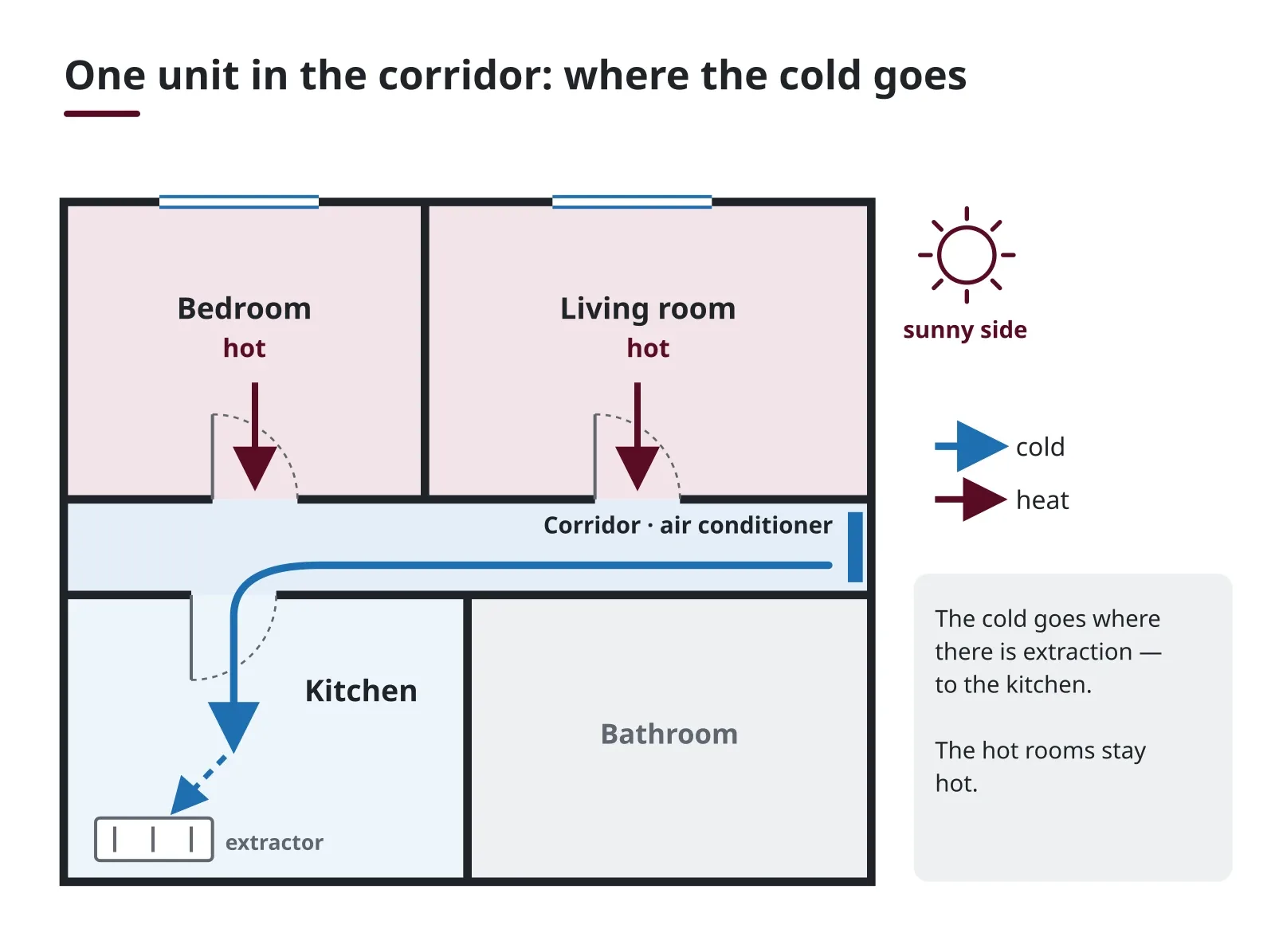
So the cold goes wherever there is extraction, i.e. to the kitchen, and the hot rooms stay hot. More power does not fix this.
“A customer put a huge unit in a small hallway — an 18,000 BTU model, for 50 square metres — and the unit has to run for two hours before you feel any difference at all in a 15-square-metre bedroom. In the hallway you will have a freezer…”
— Egor Martynov, Director, Arctica Service (translated from Russian). Video, 44:14 · chapter on our site
Egor compared it to heating: “Take all the radiators and put them in the hallway. Will your flat be warm? Of course not.”
When can one air conditioner cope?
When the flat is essentially one space: a studio where the kitchen is combined with the living room. Then nothing blocks the air, and one unit of the right capacity cools the whole space. For a two- or three-room flat with separate rooms and a small hallway, Egor says, that option “simply will not work”.
How much does a unit in every room cost?
More than one big unit. Egor admits this openly:
“Many people do it because of the budget: they want to save, they do not want to pay three times for installation and three times for the unit. In fact it is more expensive, but in terms of day-to-day use, comfort… It is better to install the unit right in your room. That saves, above all, your nerves and your money, because you get comfort.”
— Egor Martynov, Director, Arctica Service (translated from Russian). Video, 44:14 · chapter on our site
For comparison, the same series, prices with installation:
| Option | What we install | With installation |
|---|---|---|
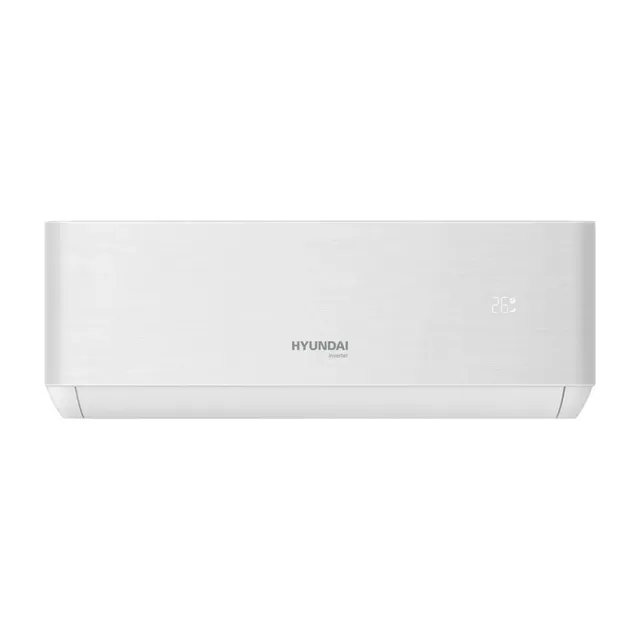
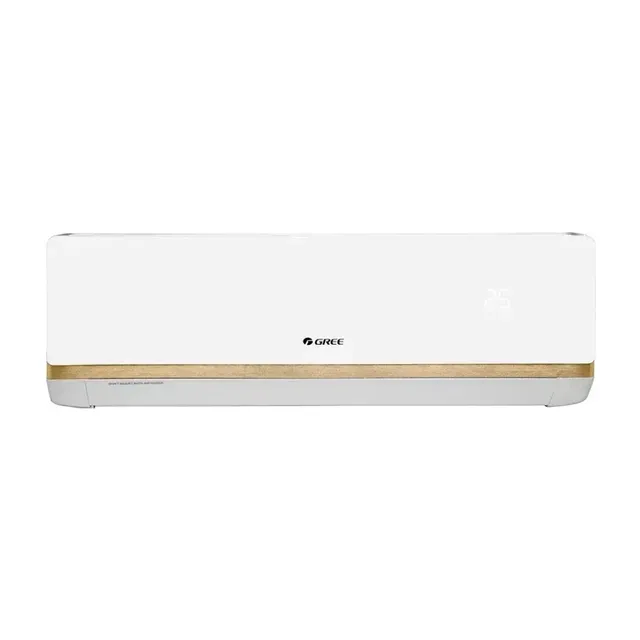
| One in the hallway | Gree Bora GWH18AAD, 18 000 BTU | 18 775 lei |
| One each in two rooms | 2 × Gree Bora GWH09AAA, 9 000 BTU | 24 680 lei |
| One each in three rooms | 3 × Gree Bora GWH09AAA, 9 000 BTU | 37 020 lei |
Prices as of 24 September 2026. “With installation” means the unit plus full installation: 1 800 lei for a 9,000 BTU model, 2 200 lei for 18,000 BTU. The refrigerant line (charged per metre from the first metre) and brackets are extra and are calculated at the free survey. Units can be bought in iute 0 % instalments; installation is paid after it is done.
There is a difference, but for it you get cool air where you sleep and work, not in the entrance hall. If the budget does not stretch to everything at once, the podcast settled on a simple answer: one room at a time, starting with the bedroom.
How do you choose the capacity for each room?
Not by floor area alone. Egor lists what the technician looks at during a consultation: floor area and ceiling height (room volume matters), the number of windows, the sunny side, floor-to-ceiling glazing. You can get it wrong either way: a unit that is too powerful or too weak.
As a guide: a 9,000 BTU model is designed for a room up to 25 m², a 12,000 BTU model for up to 35 m². Ready-made options with installation prices are on the “air conditioner for 25 m²” and “for 35 m²” pages, and for your flat, use the one-minute finder.
What if the facade only allows one outdoor unit?
Then a multi-split is worth considering: one outdoor unit and several indoor units, one per room. According to Egor, such systems cost more than two ordinary air conditioners because they are technically more complex, and people turn to them when there is only one place for the outdoor unit, for example when the developer allows just one niche. If two ordinary units can be installed, that is cheaper.
A multi-split is best planned at the renovation stage; on pipework, see “Air conditioner pipes in the wall during renovation”. The cost comparison is in “Multi-split for two rooms”, and models are in the multi-split systems section.
Article expert: Egor Martynov, Director of Arctica Service, refrigeration engineer (ONAFT, formerly the Odesa Academy of Refrigeration), in the trade since the age of 15 — he started out with his father.
The quotes come from our air conditioner podcast (video on YouTube, in Russian). Arctica Service has been on the Moldovan market for over 15 years.