In short. If you are renovating, it is best to hide the air conditioner line — copper pipes, drain and cable — in the wall now and hang the units after the finishing work. You do not have to buy the unit itself yet, but you do need to choose its capacity and model: units up to 18,000 BTU usually take 1/4 and 3/8 pipes, while more powerful ones need a specialist’s advice.
Why lay the pipework during renovation?
So that later there is no trunking on the walls, no holes in fresh finishes and no pipes on the facade.
“The renovation stage is the smartest approach to the climate of your flat, your premises. Because at this stage you can hide all the services completely: no cables, no pipes — nothing is visible. And there will be nothing on the facade: everything runs inside the room and comes out at the outdoor unit and the indoor unit.”
— Egor Martynov, Director, Arctica Service (translated from Russian). Video, 49:04 · chapter on our site
“Especially in new builds — there you need to do it. Lay the pipes, because later many people do not want to spoil the renovation, the walls and so on. In any case it is cheaper to lay the pipes now and buy the equipment later.”
— Egor Martynov, Director, Arctica Service (translated from Russian). Video, 49:04 · chapter on our site
Do you need to buy the air conditioner in advance?
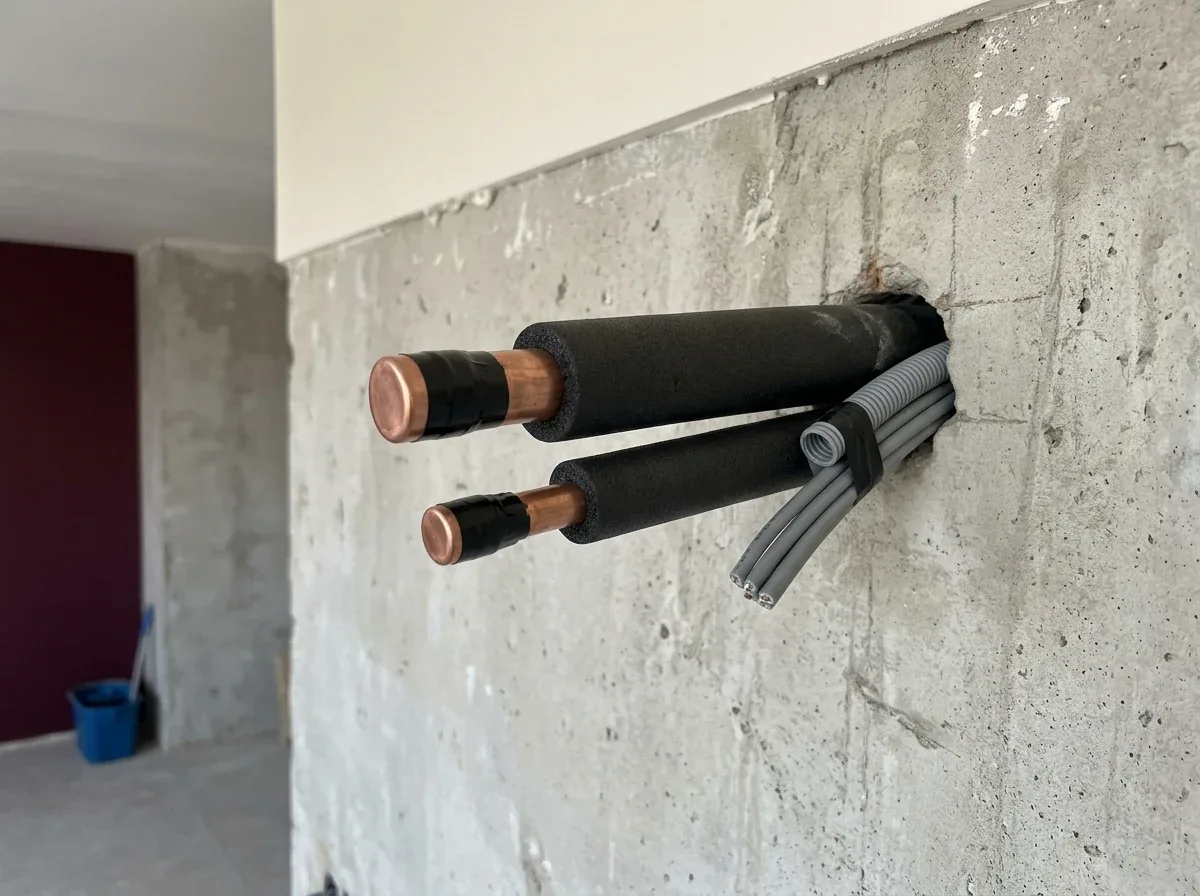
Not necessarily. What matters more is deciding its capacity in advance, because the pipe diameter depends on it.
“If the unit’s capacity is below 18,000 BTU, the standard pipes are 1/4 and 3/8. They are used everywhere, it is the gold standard, sometimes even on 18,000 models. But if we are talking about more powerful units — for example, you are installing in a large studio — then yes, you need a specialist’s advice there…”
— Egor Martynov, Director, Arctica Service (translated from Russian). Video, 49:04 · chapter on our site
So: for an ordinary bedroom or living room (7,000–12,000 BTU models) the pipes are standard and can be laid without buying the unit. For a large studio or living room that will need 18,000 BTU or more, choose the model first, then cut the chase. If the unit is already bought, even better: the technician will route the line exactly for it.
What exactly to lay: a checklist
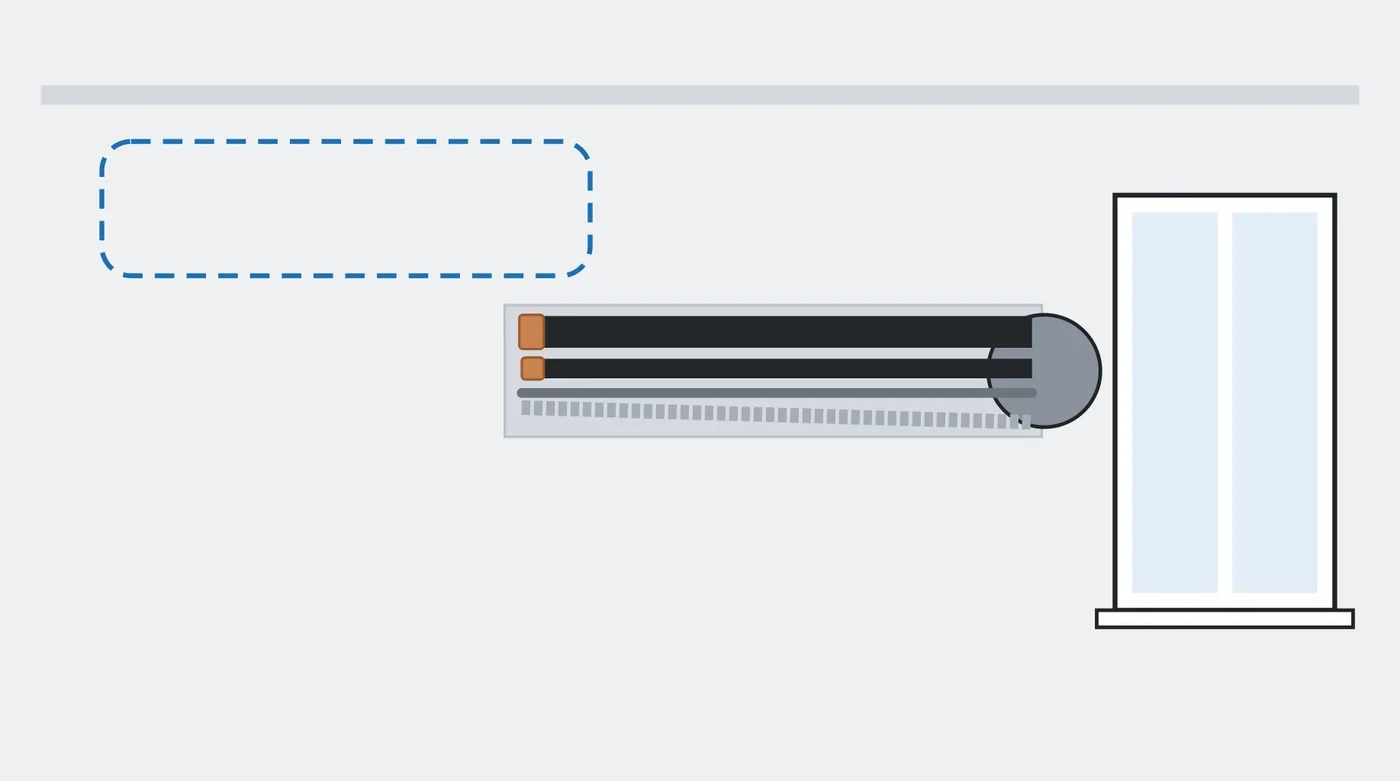
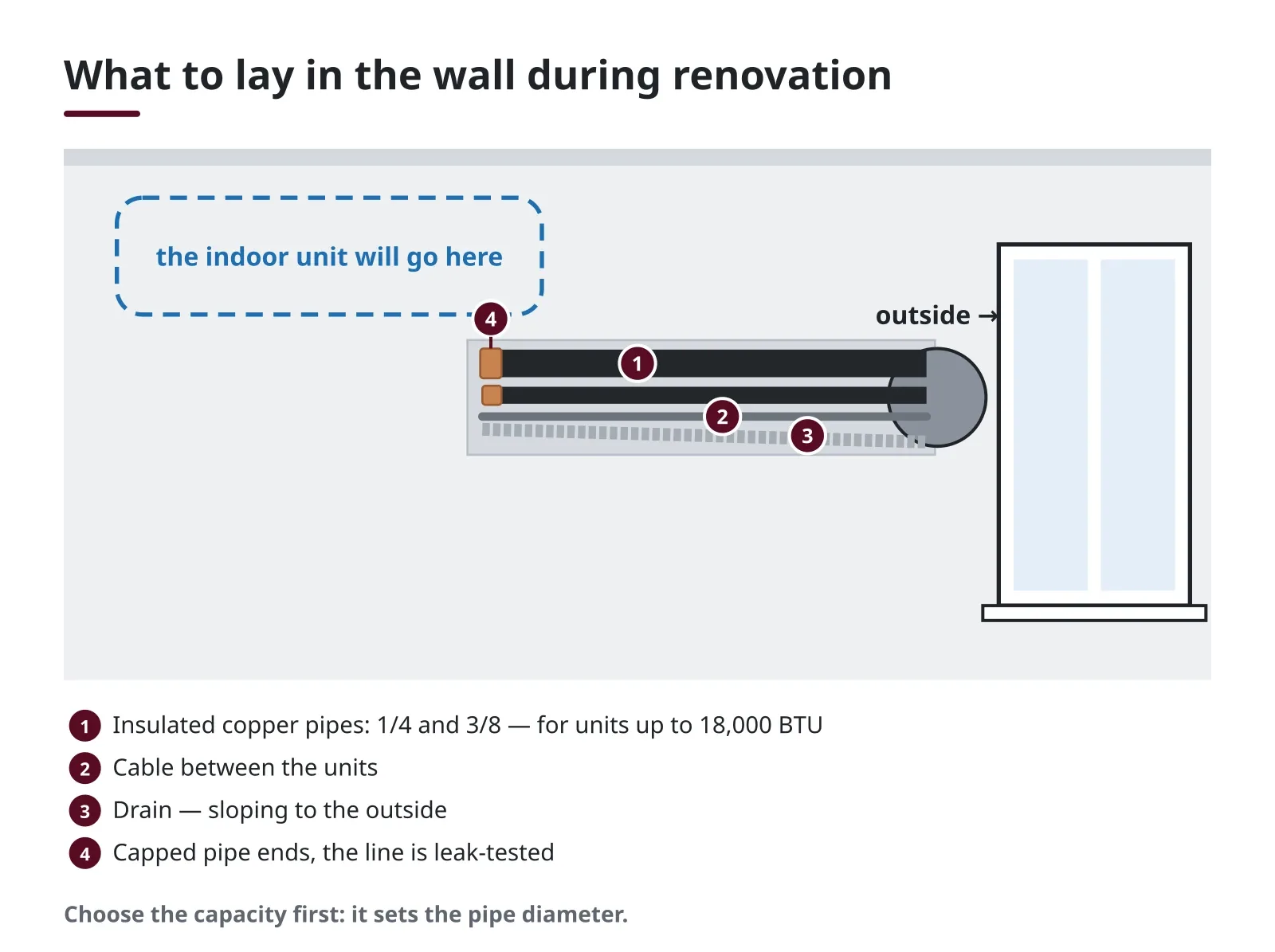
- Unit positions. Where the indoor unit goes (not above the bed or a radiator) and where the outdoor unit goes: on the facade, on the balcony or in the niche the developer allows.
- The line. Two insulated copper pipes sized for the chosen model.
- The drain: a condensate pipe routed outside or to the sewer.
- The cable between the units and the unit’s power supply.
- Caps and a nitrogen pressure test: the pipe ends are sealed and the line is tested for leaks before it is plastered over.
- A report with photos of what is where. Useful for the installers, and for you if a year later you decide to put up a shelf.
What if you want a multi-split?
A multi-split, one outdoor unit for several rooms, is used when there is only one place for the outdoor unit. The lines from all the indoor units converge on it, and they almost always have to be laid during renovation.
“Such systems first of all need preparation at the renovation stage, because it does not always work out as “wall to wall, and straight outside”.”
— Egor Martynov, Director, Arctica Service (translated from Russian). Video, 46:48 · chapter on our site
If there is room on the facade for separate units, two ordinary air conditioners will, Egor says, be cheaper. More in the article “One air conditioner in the hallway for the whole flat”.
How much does two-stage installation cost?
Stage 1 is the pipework during renovation, stage 2 is the units after renovation. Together they cost more than a standard installation in a finished flat, but you get no trunking and no damaged finishes.
| Room | Stage 1 (pipework) | Stage 2 (units) | Standard installation, for comparison |
|---|---|---|---|
| up to 35 m² | 1 300 lei | 1 500 lei | 1 800 lei |
| 40–55 m² | 1 600 lei | 1 800 lei | 2 200 lei |
| 60–80 m² | 2 000 lei | 2 000 lei | 2 400 lei |
| 80–100 m² | 2 200 lei | 2 500 lei | 2 800 lei |
Materials and extra work are charged separately: the line costs 400 lei per metre for 7,000–12,000 BTU models and 550 lei per metre for 18,000–24,000 BTU; chasing costs 150 lei per metre, 200 lei in reinforced concrete. Prices as of 24 September 2026. The technician draws up an exact quote at the free survey.
More on the stages on the “Stage 1: pipework during renovation” and “Stage 2” pages; the full price list is on the installation page.
Article expert: Egor Martynov, Director of Arctica Service, refrigeration engineer (ONAFT, formerly the Odesa Academy of Refrigeration), in the trade since the age of 15 — he started out with his father.
The quotes come from our air conditioner podcast (video on YouTube, in Russian). Arctica Service has been on the Moldovan market for over 15 years.